Aug 2, 2010

National Geographic Interactive|

National Geographic Interactive — August Issue

In this dynamic issue: Dive into Beauty, Danger and Discovery with Bahamas Blue Holes.

Discover your world with award-winning photography, in-depth videos, animated slideshows and more exclusive content. Read it on your iPad, mac & pc!
get it now

National Geographic Interactive

The Responsible Tourism Awards organised by responsibletravel.com

Tourism Fiji
2010 sponsor of the Best in a marine environment category

Fiji, 'The Soft Coral Capital of the World', is made up of 333 islands surrounded by reefs and diverse underwater terrain. It is rated as one of the world's top ten dive destinations and is a South Pacific marine paradise famous for its white sand, palm fringed beaches, azure lagoons and exceptional reefs.

World famous marine biologist Jean-Michel Cousteau says of Fiji: "The unparalleled range of quality dive sites and sheer diversity of life of the reefs is overwhelming."

Tourism Fiji is dedicated to promoting and protecting this special, and in parts very fragile, marine environment and has long supported and actively encouraged sustainable tourism. Fiji Tourism's UK and Ireland representative, Jane West emphasises the importance of this work: "As a tourist board it is vital to educate all visitors to be both socially and environmentally responsible for the benefit of, most importantly, the Fijian people and future tourists to their wonderful country."

To help project the eco-systems, Tourism Fiji works with partners to conserve Fiji's marine biodiversity by encouraging guests not to remove items, especially coral, from the reefs and requesting they do not purchase souvenir products made from coral or endangered plants or animals.

Many of the country's leading resorts offer diving adventures. One of them, Matava, has just a won the Project AWARE Marine Environmental category at the PADI Asia Pacific Member Awards. The award rewards vision, excellence and pursuit of conservation to ensure the enjoyment of underwater environments for future generations.

The Responsible Tourism Awards organised by responsibletravel.com

Jul 26, 2010

Divers and Dental Professionals Combine Work and Passion for Scuba Diving Through Fiji Project

Returning from that trip I decided to pioneer a Dental Mission. I partnered with Coach Ramey Stroud, a Mill City diver, and Stuart Gow, Director of the Matava Eco-Resort on the island of Kadavu. Together we identified dates for our trip, solicited the cooperation of Air Pacific, the national airline of Fiji, the Fiji Islands Hotel and Tourism Association and the Fiji Ministry of Health. Salem Hospital generously shared information about our trip with their staff.


I traveled with Dr. Mike and Mrs. Carrie Litchfield and Dr. Sean Hanson of Salem and Jim and Gina Jepsen from Ione, Oregon. Dave Beard from Tasmania met us at Matava and joined our team.

Air Pacific allowed us each to bring an extra 50 pounds of medical gear. Mike and Sean had received hundreds of toothbrushes, toothpaste samples and dental supplies from their suppliers. Mike brought a portable dental station as well.


Our arrival at Matava was met with excitement. Maggie, the Fijian concierge, let us know that he had shared the news of the American dentists arriving three weeks earlier with the village council. He had made arrangements for us to visit the village the next day to meet with the Chief, the Director of the School (whose classroom’s we planned to use for the clinic) and the village nurse (representative of the Ministry of Health). We took an open boat to the village, walked past sleeping dogs, feeding chickens, children playing, men unloading cinderblocks and women washing clothes.

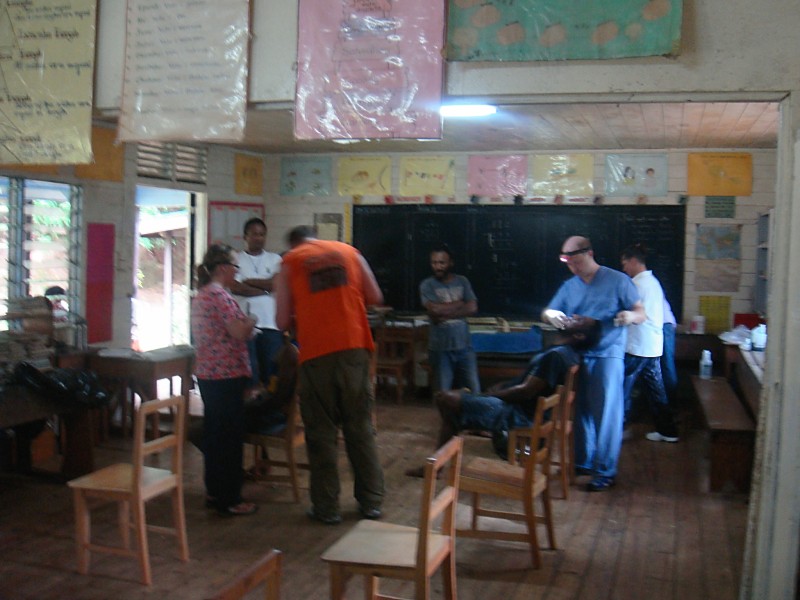
Our plan was pretty simple; breakfast, a two tank dive then lunch. We opened the clinic at 1:30 and treated patients until dark. Power in the classroom was limited to a single neon lamp powered by a new generator. We had come equipped with flashlights for diving and lighting up teeth.


Each afternoon the number of patients grew as word of our clinic spread. The third day we planned to hold an instructional clinic for the village children to share toothbrushes and toothpaste. Carrie Litchfield, an elementary school librarian in Salem was our point person. Using humor, laughter and smiles, Carrie warmed up the kids, taught basic oral hygiene and brushing technique and passed out over 200 toothbrushes and tubes of toothpaste.

We knew that dental care in the village was extremely limited. We learned that a boat ride to Vunisea, location of the regional hospital an hour away, has a cost of nearly a week's wages each way.


During our stay we had the opportunity to serve nearly 200 villagers from Kadavu Koro. Carrie taught 75 children how to brush their teeth. Numerous rotted, damaged and decayed teeth were removed, mostly from adults, a few from children.


We met many wonderful people during our visit to Kadavu Koro and our stay at the Matava Eco-Resort. We dove the Great Astrolabe Reef most mornings and provided dental care in the afternoon. Our Mission provided an opportunity to provide care for those in need and an education about preserving one's teeth to the children of the village.

Divers and Dental Professionals Combine Work and Passion for Scuba Diving Through Fiji Project - Matava - Fijis Premier Eco Adventure Resort

Jul 20, 2010

NatureFiji-MareqetiViti: Peach Palm Seeds Arrive

Sago 'heart of palm' can now be phased out by the introdcution of Peach Palm

Over 200 sago palms are felled each week to supply the local heart of palm market. But the Fiji Sago Palm is now severly threatened by unrestricted harvesting and felling not just for palm heart, but for thatching by the tourist industry. The Fiji Sago Palm is essentially restricted to the province of Serua and there are no more than six viable stands surviving.


NFMV has identified the Peach Palm as the most suitable substitute for "Heart of Palm" or "Millionaire's Salad",it is grown commercially for this purpose in Hawaii and Central America. With Biosecurity Clearance obtained, NFMV have imported 3,000 seeds and will grow out a seed orchard and a commercial stand on their land in the Sigatoka Valley. As soon as seeds are available they will be made available to other farmers and to existing suppliers of Sago Palm heart.

Commercial Peach Palm Orchard. Each palm has multiple stems and so harvesting does not result in death of the palm.
The introduction of the Peach Palm now enables NFMV to submit the Fiji Sago Palm Species Recovery Plan for endorsement by the Department of the Environment and other stakeholders, notably the Dept. of Forestry, the Serua Provincial Office and the National Trust for Fiji. In the coming months NFMV will be giving presentations to the tourism industry on the sutainable use of Sago Thatch and the potential of 'heart of palm' from Peach Palm as a new culinary item.

The Peach Palm is an ideal species for commercial 'heart of palm' cultivation because it is a clumping palm with several stems, so that as one stem is harvested, another is growing in its place for future harvest. Sago, apart from being a severely threatened species, has a single trunk and so harvesting is a permanent loss.


Heart of Sago Palms for sale on the Queen's Road. Yes this species is as endangered as Fiji's Turtles.

At Culanuku, NFMV have been working with the village community to restore a 30 ha stand of sago which was threatened with complete loss after over-harvesting enable weedy trees and vines to suppress regeneration. After two years and funding by the British High Commission, the stand has recovered well and in another two years, the first harvest of leaves for thatching could start and continue as a source of income. NFMV have drawn up sustainable thatch harvesting guidelines for Sago which are available to all who request them.


Additional Downloads

NatureFiji-MareqetiViti

August Adventure Travel Special

August Special

Don;t miss your chance to extend your saty at Matava - Fiji's Premier Eco Adventure Resort during the whole month of August.

Pay 4: Stay 6
or
Pay 6: Stay 8

August Madness has set in at Matava.Use this great deal to do even more of your favorite activities like diving or fishing.

Read More


Book your August-Pay-Stay Special Now!

Click here to book your adventure travel with the August-Pay-Stay Special to the Fiji Islands today!

Book The August-Pay-Stay Special
now using Promotional Code:

August-Pay-Stay

Matava - Fijis Premier Eco Adventure Resort

Jul 18, 2010

Dentists & Matava Foundation in Kadavu, 2010

Divers and Medical Professionals Combine Work and Passion for Scuba Diving Through Fiji Project
www.hydrosports.com/MatavaMemories.html
www.Matava.com

Jul 17, 2010

It’s important to keep oneself protected against mosquitoes

feasting mosquito

Mosquito season is in full swing and, as a non-fan of bad smelling and potentially toxic commercial skeeter-repelling products, I’ve found myself, along with my family, hiding indoors at dusk. Peak feasting hours. We live in a heavily wooded neighborhood with streams and ponds. A mosquito’s dream world. When we first moved here, my husband and I swore aliens were in our midst—an eery, other-worldly baritone hum accompanied by a slow-flashing light around 1 or 2AM, disturbing our sleep just enough to make us think we were dreaming. “Did you hear that weird sound last night?” Craig asked one morning. “You heard it, too?” Eventually, we found out that it was a mosquito-control spraying truck.

While it’s important to keep oneself protected against mosquitoes, which can transmit serious disease such as West Nile virus, malaria, and eastern equine encephalitis (EEE), I can’t help but wonder… How safe are these products that we spray on our children from head-to-toe? Are there natural measures one can take to reduce mosquito population, deter them from gnawing on your arm, and possibly even keep their annoying buzz at a distance? And one question that has been nagging at my 8-year old: “Why does the world need mosquitoes?” These are just some of the questions I will address in this series about mosquitoes, which will also include my family’s first-hand experience with natural solutions. Hopefully the information will help you to navigate through the rest of your summer with fewer mosquito bites and less reliance on chemical-ridden repellents.

Full article here: Warning: Fending Off Mosquitoes May be Harmful to Your Health « I Count for myEARTH

Jul 5, 2010

HydroSports : Dental Mission Impressions Part 1

I was so looking forward to our trip to Fiji. I was as excited about being able to help people as I was to be diving. I couldn't hardly wait!

I was a little nervous as I looked at the Matava web-site...very remote. Wasn't quite sure about being so remote. I was wondering what I was getting into when we got to the "dock" and loaded up in the boat to get to the resort. Oh boy! But I found myself being truly amazed and awe struck. What a beautiful Resort, wonderful people, and the remoteness, being off the grid, was actually quite great. I couldn't have imagined the peace and wonder before going as being real. But it is real! I felt so welcome. I know I didn't want to leave!!

Still find myself thinking about being there. I want to do more for the people. Just knowing that our helping them saved them so much time and their hard earned money and long term pain warmed my heart. The people were so very appreciative of the help and anything we did. They did not expect it! Just appreciated. So different from what I see here in the US. I want to experience the freedom from possessions, freedom from technology, and the peace some more. I think everyone should be able to experience what I did at least once in their life. Just an amazing experience.

I loved the diving. Oh my, how beautiful it was under the water. Warm, so full of life, clean and seeing the way our divemasters care. The sparkle in their eyes. It was a lot of work, no laying in the sun, no pina coladas on the beach, but in my book and heart it was the best!! Definitely a life changing experience, puts things into perspective and made me look deeper at myself and what is truly important to me . Yes, I would love to go again. I think it would be a good place for other diver's (and medical personnel) to consider.

No, it isn't for everyone, but they really would be missing out on "heaven on earth" in my opinion!!

HydroSports http://www.hydrosports.com/

Jun 14, 2010

Matava moments

Hello all at Matava,
 
Just wanted to say how much we enjoyed our week with you recently. The diving of course was spectacular and the atmosphere at the resort was wonderful. It is a credit to you all.

Thank you so much for your generosity in giving the week as a prize package, I can see why people would come half way round the world for such an experience. Now we are home and back into the routine of everyday life, but still find ourselves having "Matava moments" where our thoughts drift back to the manta rays, the food, the peace and remoteness, and the wonderful people we met. 
Hopefully will come back some day, but in the meantime are spreading the word about such a paradise. All the best...
 
Paul and Sophie (Australia)

Jun 13, 2010

Mt. Nabukelevu, also known as Mt. Washington, is Kadavu’s highest mountain and has the largest area of montane forest on the island

NatureFiji-MareqetiViti was invited by Birdlife International Fiji Programme to present at a two day workshop at Daviqele Village, Kadavu on the” Mount Nabukelevu Important Bird Area (IBA) Management Planning Workshop. The site was declared an IBA as it holds four bird species endemic to Kadavu Island, and may also hold nesting colonies of threatened sea birds. BL-I initially began conservation activities in Kadavu in 2005, leading to the establishment of a Site Support Group (SSG) with representatives from the four villagers around Mt. Nabukelevu which are, Lomati, Nabukelevuira, Daviqele and Kabariki.
Nabukelevu (Mt Washington) dominates west Kadavu and contains some of the last montane forest on the island
NFMV conservation officer Kelera Macedru attended the two day workshop (13th - 14th April 2010) presenting to the forty participants at the workshop, on endangered species that NFMV was and is currently working on. Other facilitators at the workshop were from the Dept. of Agriculture (Epeli Dugucagi and Seremaia Namanuloa ), Land Use section (Solomone Nagaunavou), Dept. of Forestry (Jone Rawasoi), Dept. of Fisheries ( Seru Batibasaga) led by Birdlife International (Tuvere Tuamoto and Mere Valu). Each topic presented at the meeting by the facilitators was designed to help the participants with the concept of ‘Connectivity’ of the natural ecosystem, of which the communities are now a part, stressing the responsibility of the people in caring for their environment. At the end of the two day workshop, leaders of land owning units, marked out boundaries of their land that are part of Mt. Nabukelevu, on a map, agreeing to protect the site for 20 years with a periodic review of every 5 years. The community-declared protected area on the top most part of Mt. Nabukelevu now includes 10 mataqali (clan) lands plus a native reserve.

Participants off the Daviqele Workshop in Kadavu

As the workshop was held during the one week celebration of “Plant a million trees campaign”, 20 young Vesi Intsia bijuga trees were planted on the last day of workshop, commemorating the signing of the MOU by landowning leaders for Mt. Nabukelevu IBA and in support of the campaign. The numbers of trees planted have been recorded by the Department of Forestry as part of the one million trees target. Tui Nabukelevu was the first to plant a tree near the shores of Daviqele village, followed by village elders, SSG representatives and workshop participants.

Work on drafting a Management plan for the community declared Protected Area will be an ongoing event, for SSG Members, relevant members of the community and Birdlife International.

Tui Nabukelevu planting a vesi tree to close the workshop

NatureFiji-MareqetiViti