Apr 12, 2026

FIJI HEALTH ALERT: DANGEROUS BOX JELLYFISH SIGHTED – TAKE PRECAUTIONS

 HEALTH ALERT: DANGEROUS BOX JELLYFISH SIGHTED – TAKE PRECAUTIONS

The Ministry of Health & Medical Services, with the Ministry of Fisheries, are urging Fijians to take precautionary measures when out at sea with the presence of Box Jellyfish - a poisonous and venomous jellyfish.
The Ministry of Health & Medical Services is concerned after a number of patients have been presented to the Ministry's Hyperbaric Unit with breathing problems after being out at sea.
Members of the public are urged to take proper heed of this advisory and to visit your nearest healthcare facility should you have any signs and symptoms.

Oct 24, 2025

Discover Fiji’s Wild Side in the Great Southern BioBlitz 2025! 🌏

Join us from 24–27 October 2025 as Fiji takes part in the Great Southern BioBlitz (GSB25) — a global event to record as many species as possible in just a few days!

You can take part by becoming a citizen scientist — simply explore your home, garden, backyard, or any nearby area, take photos of any plants, animals, or fungi you see, and upload them to iNaturalist.

🐾 How to Join:

  1. Download the iNaturalist app on your phone and sign up.

  2. Join the project: Great Southern BioBlitz 2025 – Fiji.

  3. Take clear photos of the triple F's - fungi, flora, and fauna (terrestrial and/or marine) you see from 24–27 October 2025.

  4. Upload your observations to the "Great Southern BioBlitz 2025 – Fiji"  project on iNaturalist by 10 November 2025.

Why It Matters:

  • Help scientists learn more about Fiji’s biodiversity
  • Contribute data that supports conservation and research
  • Discover the amazing species living around you!

Let’s work together to record and celebrate the beautiful biodiversity of Fiji. Every observation counts!

#GSB25 #FijiBioBlitz #CitizenScience #iNaturalist #BiodiversityFiji


Check out where others are recording species for the 2025 Great Southern Bioblitz

Aug 29, 2025

Where adventure meets soul: Fiji for the curious traveller - Sharon Stephenson


Should you find yourself in Fiji on a weekday between 6.30am and 2pm, here’s what you should do. Point your rental car south, putting 60km between yourself and Nadi, until you reach Sigatoka. Scoot a little further along the Coral Coast and you’ll arrive at Bula Coffee.

Here, tucked between a thick clot of coffee trees, you’ll find Luke Fryett. Originally from Tauranga, Fryett started Fiji’s first coffee business almost by default.

“I’d been visiting Fiji for years and discovered what I thought were cherry trees but were actually coffee trees growing wild in the highlands,” says Fryett. “The beans weren’t being used and although I don’t have a background in coffee, I realised we could do something with them.”

Roll the clock forward 14 years and Bula Coffee now uses beans from around 5000 growers across Fiji, most of them women. Not only has the business helped support women’s co-operatives and taught local farmers how to plant, prune and process their coffee crops, it’s also funded university educations and a boat to transport village kids to school.

Saying Fiji is popular with Kiwis is a bit like saying Liam Lawson is a fast driver. Alongside so many others, I’ve often escaped winter with a well-earned flop and drop holiday in this archipelago of 300+ islands strung across the Pacific like a necklace.

But there’s another Fiji beyond the cruises and increasingly ritzy resorts. On a 16-day Intrepid Travel tour of Fiji and Samoa, I discover that getting off the beaten track can be just as rewarding as drinking cocktails while staring at a sea so blue it looks AI generated.

Once caffeinated at Fryett’s waterfront cafe, we drive to Sigatoka Sand Dunes National Park, Fiji’s first national park. The heat is so thick we could almost lean on it, so it’s a relief to wander through shady mahogany forests to the dunes where, it’s rumoured, the Fijian rugby team often trains.

Sadly there’s no sign of rugby players today, just 263ha of sculpted sand and a windswept coastline where the Pacific meets the land in dramatic style. One of Intrepid’s core pillars is benefiting local tourism providers and on a whitewater rafting trip of the Upper Navua Gorge, we do just that.

Rivers Fiji was started in 1998 and the company has subsequently created a conservation area alongside the river. As local guide Semi Naivalu expertly steers us through a dramatic landscape which appears to have borrowed its blueprint from Jurassic Park-towering gorge walls, thick rain-forest and endless waterfalls – he tells us how the venture has generated more than FJ$1 million (NZ$744,920) for communities along the river. For this whitewater rafting novice, it’s also a lot of fun.

We tick off another Intrepid value – a deeply personal encounter with local communities - at our next stop, Naga Village. Deep in Fiji’s heartland, where few tourists seem to tread, is this village of 100 or so people, who open their kitchen and their hearts to us.

I wasn’t expecting to be served such a delicious meal out in the middle of nowhere. More fool me because the generous spread, which reflects Fiji’s multicultural makeup, includes taro and meat from the lovo (hāngī) as well as spicy dahl, rice and roti.

Full and happy after a traditional kava ceremony, we roll out mattresses to sleep marae - style in the village hall. It’s so surprisingly comfortable that it’s hard to spring out of bed at dawn to hike to Nabutautau Village – an 11km route that follows goat tracks used by local farmers through grassland and rainforest.

We do three river crossings, scramble over boulders as big as my car and rappel down a cliff - face before finishing with a near vertical path.

Baked by the midday sun, it’s one of the hardest treks I’ve ever done. But the reward of a swim in the clear river, a late lunch at Nabutautau Village, and the kind of untouched scenery you only get in travel brochures, more than makes up for it.

After decadently long, hot showers, we’re ready for some urban action. If you’re visiting Suva, and there’s every reason you should, definitely seek out Peter Sipeli.

The multi-talented poet, artist, gay rights activist and all-round nice guy started his company, Guided Walking Tours of Suva, in 2022. His 2.5 hour tour of the capital and Fiji’s largest city is, stresses Sipeli, a decolonised tour.

“I’m not interested in talking abut the colonial history of Suva but in the Fijian and Indian experience,” he says. We start our tour at the gloriously chaotic bus terminal, used by more than 10,000 passengers a day, to the Suva Municipal Market. Here on the ground floor, locals snack on boiled fish and cassava before heading to work.

“You should see how busy this place is on a Saturday,” says Sipeli of the market which opened in 1932. At the downstairs produce market we pass stacks of tropical fruit and vegetables such as yams, taro, coconut and the biggest mangoes and pawpaw I’ve ever seen.

Bundles of yaqona root, which is shredded and soaked in water to create Fiji’s favourite drink, kava, are piled near fragrant spices that form the backbone of Indian cooking.

We walk through Suva’s CBD, popping into the compact Reserve Bank to admire the world’s only $7 note, issued to commemorate Fiji’s first Olympic medal when its Fiji men’s rugby sevens team won gold at the 2017 games, and stroll past gracious government buildings to Thurston Gardens. The site of Suva’s first village, it’s now a lush botanical garden, where Sipeli treats us to one of his poems.

 Thurston Gardens is also home to the compact Fiji Museum, which tells the nation’s story from pottery shards dated 800-900BC to an ocean-going dura, or double-hulled canoe, and the arrival of indentured Gujarati labourers in the late 19th century.

Of particular interest is the 19th century tabua, or whale’s tooth, presented by chiefs to the Methodist Church to atone for the killing of Reverend Thomas Baker, a minister trying to spread Christianity during a time of tribal warfare and cannibalism.

It’s a Fiji far from the social media dream of palm trees and sheets with high thread counts, but when you need a diversion from sun and sea, there’s a whole other side to these stunning islands.

Fact File

  • Intrepid 16-day Samoan and Fiji Adventure, from NZ$9819. See: intrepidtravel.com
  • Getting There: Air New Zealand and Fiji Airways operates daily nonstop flights from Auckland to Nadi, and from Wellington to Nadi on Fiji Airways. See: airnewzealand.co.nz; fijiairways.com
  • Carbon footprint: Flying generates carbon emissions. To reduce your impact, consider other ways of travelling, amalgamate your trips, and when you need to fly, consider offsetting emissions.

The writer was hosted by Intrepid Travel

https://www.thepost.co.nz/travel/360790298/where-adventure-meets-soul-fiji-curious-traveller


Aug 25, 2025

Nukubati Partners with National Geographic Pristine Seas to Showcase the Great Sea Reef and Fijian Community Leadership

Nukubati Partners with National Geographic Pristine Seas to Showcase the Great Sea Reef and Fijian Community Leadership Local ownership, community connections, and dive leadership highlighted in global expedition. Macuata, Vanua Levu, Fiji [18th August 2025] 

Nukubati Island Resort is proud to announce its partnership with National Geographic Pristine Seas during their expedition to the Great Sea Reef (Cakaulevu), the world’s third-largest barrier reef system. 

The Pristine Seas team, led by renowned explorer and underwater cinematographer Manu San Félix, is in Fiji documenting the health, biodiversity, and importance of Cakaulevu. Nukubati was honoured to host and support the expedition, contributing its deep-rooted community connections, local knowledge, and conservation leadership. 

As one of the few locally owned and Fijian-led resorts in Fiji, Nukubati played a key role in facilitating community interviews with traditional leaders and fisher communities, ensuring their voices and stories are at the heart of this global conservation effort. “Our strength has always been in our people and our community networks,” said Jenny Leewai Bourke, owner of Nukubati. “Hosting National Geographic Pristine Seas is not just about showcasing our pristine environment, but also about amplifying Fijian voices, traditional knowledge, and the importance of local stewardship in protecting the Great Sea Reef.” 

Nadarivatu: Hiking and Eco-Tourism in Fiji’s Highlands - Story & Photos by Jean-Pierre Royer

 Nadarivatu: Hiking and Eco-Tourism in Fiji’s Highlands

Story & Photos by Jean-Pierre Royer

Forget the white sandy beaches and cocktails under palm trees. If you dream of an escape off the beaten path, Nadarivatu is calling. Perched at more than 800 meters above sea level in the heart of Viti Levu, this highlands area reveals a Fiji you didn’t know existed. A place where the air is fresh, ancestral legends echo through the hills, colonial history lingers, and adventure in nature unfolds.

May 28, 2025

Fiji – a place of beauty from the seat of a bike - iBike FIJI


Brad Campbell shares that what makes them unique is that almost all activities around Nadi (and Fiji in general) are water-based, for obvious reasons. Pictures: SUPPLIED

Brad Campbell is an American who moved to Fiji in 1998, and lives on the Coral Coast with his wife and family.

Nov 29, 2024

Finding paradise - author Robert Kay shares tales of South Pacific paradise Fiji


Correspondent Tom Wilmer visits with author Robert Kay about his forty year odyssey that led him from the SF Chronicle to Tahiti and onward to the islands of Fiji.

Robert Kay started writing for the San Francisco Chronicle in 1975. One thing led to another and following a stint as a bartender in Tahiti, he secured a job as a South Pacific tour guide.

Author Robert Kay
Courtesy Robert Kay
Author Robert Kay

Smitten by Fiji, Kay wrote the seminal travel book, Lonely Planet Guide to Fiji--history, economy, government, geography, and culture, points of interest on each of the major islands, and recommends hotels and restaurants. Kay subsequently co-authored, Suva—a History and Guide.

Dramatic waterfall in Fiji
Paddy Ryan: Www.Ryanphotographic.Com

Dramatic waterfall in Fiji
Book cover:
Courtesy Robert Kay
Book cover: Suva a History and Guide

 Fiji
Fiji Tourism
Fiji islet

Come along and join correspondent Tom Wilmer for a visit with author and adventurer Robert Kay for an exploration of Fiji.

Journeys of Discovery with Tom Wilmer is a featured podcast on the NPR Podcast Directory
NPR
Journeys of Discovery with Tom Wilmer is a featured podcast on the NPR Podcast Directory

You are invited to subscribe to the seven-time Lowell Thomas Award-winning travel podcast, Journeys of Discovery with Tom Wilmer, featured on the NPR Podcast DirectoryApple Podcastand more than twenty other podcast hosting sites including iHeartRadio and Spotify

Tom Wilmer produces on-air content for Issues & Ideas airing over KCBX and is producer and host of the six-time Lowell Thomas award-winning NPR podcast Journeys of Discovery with Tom Wilmer. Recorded live on-location across America and around the world, the podcasts feature the arts, culture, music, nature, history, science, wine & spirits, brewpubs, and the culinary arts--everything from baseball to exploring South Pacific atolls to interviewing the real Santa Claus in the Arctic.

Jul 24, 2024

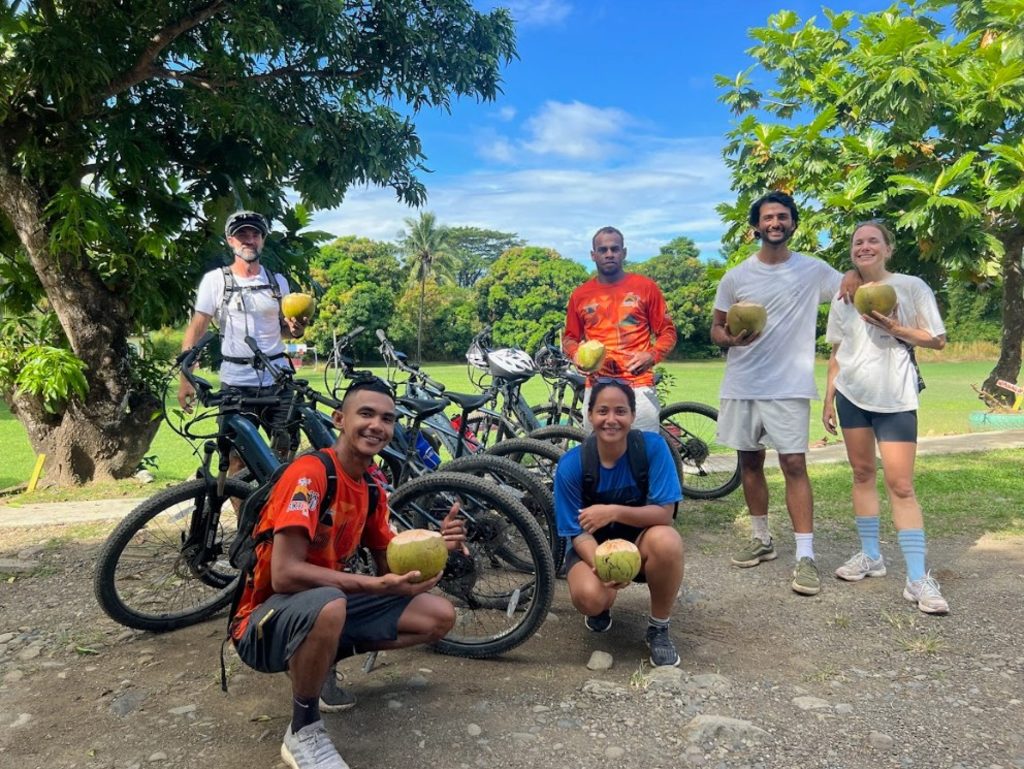
Cycle your way through the foothills of Nadi with iBike Fiji!

iBike Fiji was founded with a passion for experiencing the beauty of Fiji without boundaries. 

On electric-bicycles, you can feel the thrills of an off-road ride while hardly breaking a sweat! 

For roughly four hours, you are no longer just a tourist. 

You are an adventurer, and in the company of our competent local guides, you are invited to explore the off-road tracks of Fiji, pedaling your way through paradise. 

Adventure and immersion are the essence of iBike Fiji, and what you see can vary from day to day. 

During cutting season, you will meet sugarcane farmers toiling the fields of western Viti Levu. 

https://www.instagram.com/reel/C6-gquUvP-c/

During mango season, you will stop beneath laden mango trees and listen to stories of childhood in Fiji. 

Whatever the season, iBike Fiji gives riders a front row experience to the heartbeat of Fiji’s interior, all while taking them on a thrilling adventure. 

iBike Fiji endeavors to be a sustainable and environmentally-conscious venture, with the future of e-bicycles opening up opportunities for healthier, cleaner transport culture amongst tourists and locals alike.


Sep 18, 2023

History and Culture | A visit to Fiji’s earliest human settlement

The people of Vusama Village in the district of Malomalo in Nadroga/Navosa are richly endowed with nature and history.

According to information passed down orally through countless generations, their ancestors were regarded as Fiji’s first traditional salt makers.

They produced salt by cooking seawater in large handmade clay pots and used it as a barterable commodity and traditional item of value.

Today, the saltwater wells that used to provide the raw material for salt production sit idle on the maqa, the expanse of mangrove mudflats located over a kilometre outside the village.

The barren brine pits remind villagers of the past and their former glory days.

In olden times, the area may have possibly been a region that bustled with activities.

But salt and salt making are not the only popular features of Vusama.

Archaeological excavation in Bourewa. Picture: WIKIEDUCATOR.ORG


A few kilometres from the village, adjacent to a beachfront on what is called the Rove peninsular, is a place villagers call Bourewa, believed to be the first place to be settled in Fiji before the birth of Christ.

In the local dialect, the word bourewa translates to two words, ‘bou’ meaning a bure post and ‘rewa’ meaning high rising.

“Bourewa was where we used to go to catch fish using fishing nets,” said former village headman, Saula Nadokonivalu.

The place rose to prominence in 2003 when local archaeologists led by University of the South Pacific professor, Patrick D. Nunn, discovered at Bourewa the oldest human settlement in Fiji.

Then, it was part of a sugarcane field.

Through radio carbon dating, experts believe Bourewa was established about 3100 years ago, that is, 1150 BC, on what was then a smallish island off the coast of Viti Levu.

That island has since joined the mainland.

According to Nunn the first people who arrived and settled at Bourewa had “probably travelled across at least 950 kilometres of open ocean from the islands of what we now call Vanuatu”.

“Attracted to Bourewa by its massive and pristine fringing coral reef, the people built stilt platforms across the inner reef and lived there for a few hundred years before the sea level fell and the amount of food obtainable from this reef declined,” Nunn said.

Why the Lapita people favoured living in structures built on stilts on the reef rather than simply living on one of the hills, 30-40 metres away, was a mystery that baffled Nunn and his team.

Vusama Village elders have no recollection of traditional dances (meke) or specific stories that explain how Bourewa came to be.

However, they said that according to old stories passed down from their ancestors, in the days canoes arrived at Vuda, smoke was first spotted rising from Bourewa, suggesting people already settled there.

“All those stories connected with the excavations and discoveries by Patrick Nunn and his team in 2003,” Ms Nadokonivalu said.

Nunn and his close colleagues, Sepeti Matararaba and Roselyn Kumar, spent six years excavating the Bourewa site.

In December 2008, through a grant from the Government of France, a series of six posters illustrating different aspects of the Bourewa discoveries were published and displayed at the 18th Annual Conference of the Pacific History Association in December 2008.

The Sunday Times team was invited to visit Bourewa in late August.

Bourewa is today covered by an undergrowth of shrubs and coastal trees.

The original settlers of Bourewa lived largely on seafood such as seashells and fish and were amazing potters.

In fact, pieces of pottery excavated from the area showed designs consistent with other Lapita settlements and potsherds.

They featured intricate repeated geometric patterns that occasionally included faces and figures.

The patterns were etched into the pots before firing with a comblike tool used to stamp designs into wet clay. Lapita pots were not formed using a potter’s wheel but by the use of bare hands.

Nunn’s archaeological team also found stones believed to be tools for “woodworking, shaping and smoothing”.

“That’s where the remains of a woman holding her child were dug out from,” Mr Nadokonivalu explained.

“Here a bowl of jewellery pieces was found.”

The early settlers of Bourewa seemed exceptional jewellery designers.

They made ‘bracelets’ and other jewellery using conus shells (which is suited for making rings and pendants), dilled beads and were able to carve shells and drill fine holes in them.

In January 2008, Matararaba discovered an upturned base of a pottery bowl and along both sides, in a parallel manner, was a line of three conus shells.

When he turned the bowl, he saw that it was filled with a collection of shell jewellery.

The excavators concluded the jewellery was a prised collection that had been deliberately buried, perhaps belonging to a Lapita princess.

Looking out to sea, one cannot stop wondering what lured the first settlers at Bourewa to chose the place.

“Was it the weather, the vegetation, an abundance of food, water source or the natural asthetics?” I asked myself.

Information gleaned from text on the Bourewa excavations between 2003 and 2009 trochus shells (tovu) and two local species of extinct clams or vasua were also found at Bourewa, suggesting they were exploited as sources of food protein by early settlers.

Note: This article was written using information sourced largely from the site https://patricknunn.org/ and interviews with Vusama elders.

• History being the subject it is, a group’s version of events may not be the same as that held by another group. When publishing one account, it is not our intention to cause division or to disrespect other oral traditions. Those with a different version can contact us so we can publish your account of history too — Editor.

https://www.fijitimes.com/history-and-culture-a-visit-to-fijis-earliest-human-settlement/

Sep 6, 2023

Why exploring Fiji’s tropical rainforest in Suva is for everyone

 Megan Watts swaps the hustle and bustle of Auckland for the rich rainforests of Fiji - and learns a few life lessons along the way.

https://www.nzherald.co.nz/travel/why-exploring-fijis-tropical-rainforest-in-suva-is-for-everyone/KPQZFTCA4VHMPGFYX4ISFIGIJA/

When I arrived at the Kila Eco Adventure Park in Suva - part of a day trip excursion on my P&O cruise - what I was expecting was a walk in the dense rainforest with a few landscape snaps to send to the family at home. What I wasn’t expecting was the longest zipline in Fiji and a 12-metre-high obstacle course - not for the faint of heart.

Unfortunately, my lovely tour group was riddled with back problems, knee pains and severe cases of nerves, leaving a helpless people-pleaser such as myself to brave the course by my lonesome - a task I would never take on if it weren’t for my unwavering dedication to journalism and constant fear of letting people down.

This was going to be great.

What I said “yes” to on a whim led to me being suited up with a helmet and harness, and a safety briefing, that included signing my rights away should I plummet to my death - or worse - embarrass myself extraordinarily.

So, with a big inhale and a few pats on the back, I mounted the ladder and climbed 12 metres up to gaze across the Kila rainforest. There truly is no better place to see tropical Fiji, I thought, before realising that I was, in fact, a very long way up.

Braving the obstacle course - one breath-catch at a time.

Within the next 30 minutes, I was balancing on logs, jumping off frighteningly high platforms, performing mini bungee jumps and facing my fears in the name of peer pressure.

Perhaps, the most shocking of tricks was climbing up one of the tallest ladders on the course and being told to “just step off” at the top, which saw me swing across the valley on a harness, scream like a foul-mouthed banshee and gain a rather large adrenaline rush while doing so.

Though the experience might not sound like it’s for everybody when visiting the tranquil shores of Suva, I couldn’t recommend it enough.

Not only did I win the respect and praise of my tour guide colleagues for days to come, but I truly felt that I could do anything. I was on top of the world, with my head in the sky. What’s more, I treated the rest of my trip around the Fiji islands with a sense of daring and wonder as a result.

The experience allowed me to see Fiji with new eyes and say yes to things I may have felt too scared to try if I hadn’t faced my fears on our first day in Suva. I now think that every trip should start with a 10-metre plummet, if not only for the plot, for the confidence.

A walk through the rainforest

We took the beaten track along the jungle paths. Photo / Supplied

As my adrenaline buzz wore off, we marched into the rainforest to discover what the 50 hectares of land that stretched before us had in store.

We took the beaten track along jungle paths and discovered waterfalls, the rare native flora and fauna of the region - including Fiji’s only linear botanic garden - and were treated to expansive valley and mountain views straight from a postcard.

We smelt sweet citrus lemon leaves, spicy pepper plants and cinnamon trees while gazing at the green paradise that sprawled on for acres.

Our tour guide educated us on the natural flora of the Kila rainforest. Photo / Supplied

The tour guides made the trek. Their immense knowledge of the inbound jungle and inherent connection to its offerings was a really special thing to see - we couldn’t have hoped for better mentors to teach us about the ways of the land.

They pointed out a potato-like fruit used by the locals to dye their hair brown. They showed us a plant that, when cut and boiled for 10 hours, could allegedly cure cancer. They had an understanding of the rainforest that was deeply ingrained in their Fijian heritage and expressed a perspective on life that was refreshing, particularly for someone who had escaped the hustle and bustle of Auckland for a change of pace.

I walked out of the jungle a changed woman with a thought that lingered long after my trip to Fiji - perhaps, life’s biggest lessons could be summed up by a few hours in the Kila rainforest.

I walked out of the jungle a changed woman. Photo / Supplied

Here is what I learnt: experiencing different cultures is a great way to connect to the world around you in a deeper sense. Listening to people and their stories is a privilege, for they show you parts of the world you couldn’t see by yourself. Surprises should be embraced and welcomed, they always make for good tales. A walk never fails to clear the mind and cleanse the soul.

And, most importantly, never be afraid to jump!

Megan Watts is a Lifestyle and Entertainment digital producer for the New Zealand Herald whose passions include honest journalism, star sign columns and doing things for the plot.

https://www.nzherald.co.nz/travel/why-exploring-fijis-tropical-rainforest-in-suva-is-for-everyone/KPQZFTCA4VHMPGFYX4ISFIGIJA/